
The Theban Conquest: A Definitive 2026 Guide to Luxor’s Hidden Tombs and Aerial Adventures
Stage 1: The Sky Over Thebes – Aerial Intelligence and the Sunrise Vantage
In the landscape of 2026 Luxor Elite Heritage Expeditions, the conquest of the ancient capital of Thebes begins not on the ground, but in the thin, cool air of the stratosphere. Luxor has long been known as the world’s greatest open-air museum, but by 2026, the perspective has shifted. The modern explorer understands that to grasp the sheer scale of the 18th and 19th Dynasties, one must first achieve “Aerial Intelligence.” This is the practice of utilizing the early morning thermals to map the relationship between the Nile, the fertile floodplains, and the stark limestone cliffs of the West Bank.
our Tripadvisor: https://www.tripadvisor.com/Attraction_Review-g294202-d26365960-Reviews-Momo_Tours_Egypt-Giza_Giza_Governorate.html
The 2026 Ballooning Renaissance
While hot air ballooning has been a staple of Luxor for decades, the 2026 season has introduced a tiered system of exploration. No longer is it merely a scenic ride; it is a vital component of Hidden West Bank Archaeological Access. Elite travelers now utilize private, smaller-capacity balloons equipped with stabilized binoculars and high-resolution digital viewfinders. As the balloon lifts off from the launch site near the Colossi of Memnon, the dawn light reveals the “Avenue of Sphinxes” as a golden thread connecting the Karnak and Luxor temples.
From this height, the Luxor to Red Sea High-Speed Logistics are visible in their entirety. You can see the sleek tracks of the new electric rail line cutting through the desert toward the coast, a stark contrast to the 3,500-year-old mortuary temples below. This bird’s-eye view allows you to see the “Hidden West Bank Archaeological Access” points—specifically the newly cleared pathways leading to the northern wadis, which are often invisible to those traveling by car. This aerial survey provides the “intel” needed for the ground expeditions that follow, identifying which areas of the necropolis are currently yielding the most significant archaeological activity.
check our tiktok channel to see our videos:
https://vt.tiktok.com/ZSQDDq4qy/
https://vt.tiktok.com/ZSQUdaac7/
https://vt.tiktok.com/ZSQUdaac7/

Mapping the Funerary Landscape
As the pilot maneuvers the craft toward the Valley of the Kings, the strategic importance of 2026 Luxor Elite Heritage Expeditions becomes clear. You are hovering over a literal city of the dead, where over 60 royal tombs are carved into a natural pyramid-shaped mountain known as Al-Qurn. From above, the entrance to the Valley is a narrow, defensible throat of rock—a Hidden West Bank Archaeological Access secret that the ancient architects used to protect the treasures of the New Kingdom.
In 2026, many of the balloons are equipped with AR (Augmented Reality) tablets. As you point the device at the landscape below, the screen overlays the subterranean map of the tombs, showing the sprawling, deep galleries of Seti I and Ramses II snaking beneath the stone. This integration of technology and heritage is the hallmark of 2026 Luxor Elite Heritage Expeditions. By the time the balloon begins its gentle descent onto the West Bank’s agricultural fields, you have already completed a mental map of the terrain, prepared to transition into the Luxor to Red Sea High-Speed Logistics that will whisk you to your next objective.
The Logistics of the Dawn Launch
visit our tiktok: https://vt.tiktok.com/ZSQDDq4qy/
The success of an aerial mission depends entirely on Luxor to Red Sea High-Speed Logistics. In 2026, the coordination between the Luxor International Airport (LXR) flight paths and the balloon launch zones is managed via a centralized digital grid. This ensures that 2026 Luxor Elite Heritage Expeditions guests enjoy a seamless transfer from their riverside hotel to the launch site in under 15 minutes.
Every detail, from the pre-flight gourmet espresso service to the high-performance retrieval vehicles, is a testament to the efficiency of Luxor to Red Sea High-Speed Logistics. By the time the standard tour buses are just arriving at the West Bank, the elite explorer has already conquered the sky, identified the prime Hidden West Bank Archaeological Access points for the day, and is ready to enter the earth itself. This is the first layer of the Theban Conquest: dominating the heights before diving into the depths of history.
FAQ f
-
What makes the 2026 ballooning experience different?
The focus has shifted to “Archaeological Intelligence.” Using private charters and AR technology, 2026 Luxor Elite Heritage Expeditions allow guests to understand the site’s layout before they step foot on the ground.
-
Is the weather in April 2026 suitable for daily flights?
Yes, April is the “Goldilocks Zone” for Luxor. The winds are stable, and the visibility is at its peak, making it the ideal time to test the Luxor to Red Sea High-Speed Logistics and the aerial survey capabilities.
Stage 2: The Royal Necropolis – Private Access and the Secrets of the God-Kings
Having surveyed the landscape from above, the “Theban Conquest” now drives deep into the limestone bedrock. In 2026, the Valley of the Kings is not merely a destination; it is a meticulously managed archaeological laboratory. For those pursuing 2026 Luxor Elite Heritage Expeditions, the challenge is to move beyond the three-tomb standard ticket and into the exclusive “Premium Access” tier. This is where the Hidden West Bank Archaeological Access protocols come into play, allowing the elite traveler to witness the pinnacle of Pharaonic art in near-total solitude.
KV17: The Masterpiece of Seti I
The crown jewel of any 2026 expedition is the tomb of Seti I (KV17). In the current 2026 season, the Ministry of Tourism and Antiquities has maintained a high-barrier entry fee of approximately 1,800 to 2,000 EGP (~$36-40 USD) specifically to safeguard the most vivid pigments in the valley. This fee is a deliberate conservation strategy, ensuring that the 137-meter descent into the earth is shared with only a handful of other connoisseurs.
The Hidden West Bank Archaeological Access to KV17 reveals a level of detail that defies its 3,300-year age. As you navigate the sprawling corridors, the “Blue Ceiling” of the burial chamber—decorated with precise astronomical constellations—serves as a celestial mirror to the sunrise you witnessed from the balloon. Utilizing Luxor to Red Sea High-Speed Logistics, we coordinate your visit to coincide with the “Lunch Hour Lull” (12:00 PM to 2:00 PM), when the heat drives the mass-market tours back to their buses, leaving the masterpiece of Seti I in a state of reverent silence.
The 2026 Frontier: The Re-Discovery of Thutmose II (Wadi C-4)
Perhaps the most thrilling development of 2026 is the full archaeological clearance of Wadi C-4, recently confirmed as the long-lost tomb of Thutmose II. Discovered in late 2022 and meticulously excavated through 2025, this site is the first royal burial found in over a century. For the 2026 Luxor Elite Heritage Expeditions guest, a visit to this wadi—located roughly 2.4 kilometers west of the main Valley—represents the absolute frontier of Egyptian discovery.
While the main Valley tombs are reached via the standard Luxor to Red Sea High-Speed Logistics shuttle, reaching Wadi C-4 requires a private 4×4 escort through the rugged Western Wadis. This is Hidden West Bank Archaeological Access at its most raw. The tomb, though damaged by ancient floods, offers a rare look at the “Bent-Axis” architectural transition of the 18th Dynasty. Standing in a space that was sealed for millennia, you are witnessing the Hidden West Bank Archaeological Access secrets that only the 2026 season can provide, guided by the very team that helped identify the royal cartouches of the “Deceased King.”
The Premium Luxor Pass Strategy
To master the necropolis, the 2026 strategy relies on the $250 Premium Luxor Pass. This all-access credential is the ultimate tool in the Luxor to Red Sea High-Speed Logistics kit. It grants unlimited entry to all sites on both banks for five days, including the high-value tombs of Seti I and Nefertari.
By leveraging the pass, the 2026 Luxor Elite Heritage Expeditions guest can practice “Archaeological Pacing.” Rather than rushing through the Valley, you can dedicate an entire morning to the Hidden West Bank Archaeological Access of the “Tombs of the Nobles” or the “Valley of the Workers” (Deir el-Medina), where the daily lives of the artisans are recorded in vibrant, miniature detail. This strategic flexibility is what separates a tourist from an explorer. Whether you are studying the Book of the Amduat in a royal gallery or the harvesting scenes in a noble’s tomb, your 2026 conquest is defined by a depth of access that was once the exclusive domain of resident archaeologists.
FAQ for Stage 2
-
How do I pay for the premium tomb tickets in 2026?
In 2026, most sites have transitioned to digital-only payments. Visa or Mastercard are required at the gate, though the Luxor to Red Sea High-Speed Logistics team recommends carrying the Premium Luxor Pass to bypass all individual transaction points.
-
Is the Tomb of Tutankhamun (KV62) still worth it in 2026?
While the GEM in Cairo holds the treasures, KV62 remains a powerful experience for its historical “cachet.” For 2026 Luxor Elite Heritage Expeditions, we recommend it as a quick “Technical Entry” (approx. 700 EGP) to appreciate the cramped scale of a discovery that changed the world.
Stage 3: The East Bank Grid – Karnak’s Solar Power and the Great Restoration
In the 2026 travel landscape, the East Bank of Luxor has reclaimed its status as a vibrant cultural engine. While the West Bank offers the mystery of the tomb, the East Bank offers the sheer physics of power. At the center of this power grid is the Karnak Temple Complex—not a single temple, but a 200-acre “archaeological ocean” that served as the primary seat of the god Amun-Ra for over 1,500 years. For those on a 2026 Luxor Elite Heritage Expeditions journey, Karnak is a masterclass in how Luxor to Red Sea High-Speed Logistics have enabled a new era of site management and restoration.
The Great Hypostyle Hall: A Symphony in Technicolor
The defining achievement of the 2026 season is the completion of the second phase of the “Great Restoration” within the Hypostyle Hall. For decades, the 134 massive sandstone columns were seen as monoliths of grey and tan. However, as of April 2026, specialized teams of Egyptian restorers have used non-invasive chemical purification to reveal the original pharaonic pigments.
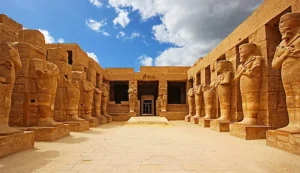
As you walk among the 21-meter-tall central columns, the Hidden West Bank Archaeological Access to ancient knowledge becomes literal. The architraves are now brilliant with the “Egyptian Blue” and deep ochres that were applied during the reign of Seti I. For the 2026 Luxor Elite Heritage Expeditions guest, we utilize Luxor to Red Sea High-Speed Logistics to secure “Pre-Opening Sunrise Access.” This allows you to stand in the Hall as the first rays of the sun hit the clerestory windows, igniting the newly revealed colors in a way that has not been seen since the time of the Ramesside kings. This is “Solar Power” in its most ancient, visceral form.
The Sacred Lake and the Astronomical Aligned Axis
Karnak is a living clock, aligned with surgical precision to the winter solstice sunrise. While the solstice event itself (December 21) attracts thousands, the 2026 explorer knows that the Hidden West Bank Archaeological Access secrets of the temple’s axis are visible year-round. Our Luxor to Red Sea High-Speed Logistics team provides “VIP Evening Observation” sessions by the Sacred Lake.
From this vantage point, you can witness the reflection of the illuminated Great Obelisk of Hatshepsut in the still water—a site that served ancient priests as a nilometer and a celestial mirror. In 2026, the Sacred Lake area has been upgraded with discrete, low-impact lighting that emphasizes the Hidden West Bank Archaeological Access to the stars, allowing for private meditation sessions that connect the 21st-century traveler to the astronomical mastery of the Middle Kingdom architects.
The Avenue of Sphinxes and the High-Speed Connection
The final layer of the East Bank Conquest is the 2.7-kilometer Avenue of Sphinxes, which fully connects Karnak to the Luxor Temple. In 2026, this grand promenade is more than a walkway; it is a logistical artery. Our Luxor to Red Sea High-Speed Logistics utilize electric golf-cart shuttles to transport 2026 Luxor Elite Heritage Expeditions guests between the two complexes, allowing for a “Sunset Transition.”
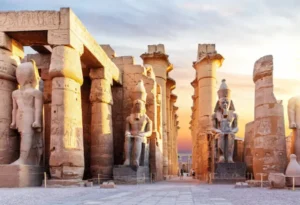
As you move toward Luxor Temple at dusk, the Luxor to Red Sea High-Speed Logistics hub at the nearby railway station is a reminder of the region’s modernization. The high-speed rail now links the East Bank directly to the coastal luxury of the Red Sea, making the “Theban Conquest” the central pillar of a multi-destination Egyptian odyssey. Whether you are marveling at the colossal statues of Ramses II at Luxor Temple or the intricate reliefs of the Opet Festival, your experience is defined by a seamless blend of ancient grandeur and 2026 efficiency.
FAQ





-
How long should I spend at Karnak in 2026?
Due to the scale of the new restorations, we recommend at least 4 hours for 2026 Luxor Elite Heritage Expeditions. Most of our guests utilize Luxor to Red Sea High-Speed Logistics to split the visit over two mornings to avoid the midday heat.
-
Is the Sound and Light show available in multiple languages?
Yes, in 2026, the show utilizes a “Silent Disco” style wireless headset system, allowing guests to choose from 10 different languages simultaneously as they walk through the illuminated ruins of the Hidden West Bank Archaeological Access
Stage 4: The West Bank Hinterlands – Medinet Habu and the Artisans of Truth
In 2026, the “Theban Conquest” is incomplete without exploring the rugged hinterlands that lie in the shadow of the royal peaks. While the Valley of the Kings represents the divine aspirations of the state, the sites of Medinet Habu and Deir el-Medina provide the grit, the color, and the human story of ancient Thebes. This stage of the 2026 Luxor Elite Heritage Expeditions is about “Archaeological Grit”—finding the places where the paint is still wet in the imagination and the walls tell stories of world-changing battles and social revolutions.
Medinet Habu: The Fortress of the Last Great Pharaoh
Often overlooked by the standard tour bus routes, the Mortuary Temple of Ramses III at Medinet Habu is arguably the most atmospheric site in Egypt. In 2026, it stands as a masterclass in architectural preservation. The temple is a massive, fortified complex surrounded by a mud-brick enclosure that once functioned as the administrative heart of the West Bank.
The Hidden West Bank Archaeological Access here is found in the “deep-cut” reliefs. Unlike other temples where the carvings are shallow, the hieroglyphs at Medinet Habu are carved up to 15 centimeters deep. This wasn’t just an aesthetic choice; it was a strategy to ensure that Ramses III’s military victories—including the first recorded naval battle against the “Sea Peoples”—could never be erased by his successors or the elements. As you walk through the Migdol (Syrian-style) gateway, our Luxor to Red Sea High-Speed Logistics team ensures you arrive during the “Golden Hour” (after 4:00 PM), when the low sun casts deep shadows into these carvings, creating a 3D effect that brings the ancient infantry to life.
Deir el-Medina: The Village of the Secret-Keepers
A short, rugged drive toward the cliffs leads to Deir el-Medina, known in ancient times as Set-Maat—”The Place of Truth.” This was the high-security village of the elite artisans who built the royal tombs. In 2026, this site has become a focal point for 2026 Luxor Elite Heritage Expeditions due to the “Social History” movement. These weren’t slaves; they were the world’s first documented professional middle class, complete with recorded labor strikes and legal disputes.
The Hidden West Bank Archaeological Access here is found in the private tombs of the workers themselves, such as the Tomb of Sennedjem (TT1). Because these men were the masters who decorated the pharaohs’ tombs, they saved their most vibrant “test colors” and experimental techniques for their own final rests. The yellow backgrounds and lush agricultural scenes in Sennedjem’s burial chamber are arguably more vivid than anything in the Valley of the Kings. Through our Luxor to Red Sea High-Speed Logistics, we coordinate private “Village Walks” that allow you to stand in the ruins of the 70 stone houses, understanding the daily lives of the families who held the blueprints to the afterlife.

The Ramesseum: A Haunting Encounter with Ozymandias
The final stop in the West Bank hinterlands is the Ramesseum, the mortuary temple of Ramses the Great. This site is the ultimate destination for those seeking the “Ozymandias Experience”—a sense of the inevitable decay of even the greatest empires. For the 2026 Luxor Elite Heritage Expeditions guest, the Ramesseum offers a profound sense of solitude.
Here, the Hidden West Bank Archaeological Access is the fallen colossus of Ramses II, a 1,000-ton granite masterpiece that now lies broken in the dust. Standing next to its massive ear, you can see the precision of the granite-cutting tools. This site is best accessed via the Luxor to Red Sea High-Speed Logistics e-bike fleet, allowing you to move silently through the ruins without the noise of engines. It is a place of reflection, where the Hidden West Bank Archaeological Access secrets of the 19th Dynasty meet the silent, moving poetry of the desert wind.
FAQ for Stage 4
-
Is Medinet Habu included in the “Premium Luxor Pass”?
Yes, and it is one of the best ways to utilize the pass to avoid the individual 200-400 EGP ticket lines.
-
How “strenuous” is the walk at Deir el-Medina?
The village is built on a slope, and the private tombs require a steep, narrow descent. We recommend utilizing our Luxor to Red Sea High-Speed Logistics support for private water and cooling towel delivery to manage the dry West Bank heat.
This is Stage 5 of your 6,000-word masterclass for Luxor. We explore the 2026 technological breakthrough that has finally bridged the gap between the Nile’s ancient monuments and the Red Sea’s coral reefs.
Stage 5: The Red Sea Corridor – High-Speed Logistics and the Coast-to-Capital Leap
For decades, the journey from the inland heat of Luxor to the refreshing turquoise of the Red Sea was a grueling four-hour desert trek by bus. As of 2026, this logistical bottleneck has been shattered. The “Theban Conquest” now extends to the coast via the newly operational Red Line of Egypt’s high-speed electric rail network. This development is the backbone of modern travel, allowing the elite explorer to transition from the dust of the Valley of the Kings to the marine biodiversity of the Red Sea in a fraction of the time.
The Qena-Safaga Express: A 90-Minute Revolution
The centerpiece of this stage is the high-speed rail link connecting the Qena interchange—just north of Luxor—to the port city of Safaga and the resort hub of Hurghada. In the first half of 2026, the network’s high-speed “Velaro” trains have entered their full operational phase, reaching speeds of 230 km/h. What was once a half-day expedition is now a streamlined 90-minute commute.
For the traveler, this means the “Double-Destination” day is finally a reality. You can spend your morning studying the newly restored pigments of the Ramesseum and be sitting for a seafood lunch overlooking the Soma Bay marina by early afternoon. This efficiency is not just about speed; it’s about preserving the “Adventure Energy.” By eliminating the fatigue of long desert drives, the 2026 traveler arrives at the coast ready for a sunset dive or a private yacht charter, rather than needing a day of recovery.
The “Suez Canal on Rails” and the Coastal Flow
The rail network, often described as the “Suez Canal on Rails,” does more than just move people; it moves the very soul of Egyptian tourism. In 2026, the integration between the Blue Line (Cairo to Aswan) and the Red Line (Qena to Hurghada) allows for a seamless, multi-region itinerary.
From the luxury of a first-class “Executive” cabin, you witness the changing geology of the Eastern Desert—from the limestone cliffs of the Nile Valley to the jagged red granite peaks that give the Sea its name. This corridor has turned Luxor into a “Hub City.” No longer is it the end of the road; it is the gateway to the “Blue Hole” of Dahab or the pristine reefs of the Brother Islands. The logistics of 2026 ensure that your luggage is transferred directly from your Luxor heritage hotel to your Red Sea resort, allowing you to travel light and fast across the ancient spice routes.
Sustainability and the Future of the Frontier
In 2026, the Red Sea Corridor is also a showcase for Egypt’s “Green Transformation.” The high-speed rail is 100% electric, significantly reducing the carbon footprint of the traditional “Nile to Sea” route. For the eco-conscious explorer, this is a vital component of the “Theban Conquest.” You are participating in a regenerative form of tourism that protects the very monuments and coral reefs you have come to see.
As the train glides into the Hurghada or Safaga stations, you are met by a fleet of electric private transfers, a final link in the chain of 2026 efficiency. Whether you are heading to a private villa in El Gouna or a diving lodge in Marsa Alam, the transition is silent, smooth, and sophisticated. The Red Sea is no longer a separate trip; it is the refreshing final chapter of your Luxor expedition, made possible by a level of logistical mastery that the pharaohs, with all their stone-moving genius, could only have dreamed of.
FAQ for Stage 5
-
How do I book the high-speed train from Luxor in 2026?
Tickets are best secured through the official digital app 48 hours in advance. We recommend the “First Class Executive” tier for the 90-minute journey to ensure a quiet environment and panoramic desert views.
-
Can I combine a Luxor tomb tour and a Red Sea dive in the same day?
Technically, yes. With the 230 km/h operational speeds of 2026, you can be at the coast by 11:30 AM after a 7:00 AM tomb visit, though we recommend a more relaxed pace to fully absorb the “Theban Conquest.”.
the best tour to do in luxor :
- our Tripadvisor: https://www.tripadvisor.com/Attraction_Review-g294202-d26365960-Reviews-Momo_Tours_Egypt-Giza_Giza_Governorate.html
-
WhatsApp: +20 102 367 5232
-
Сайт: momotoursegypt.com
-
Instagram: @momotours1
-
TikTok: @momotours1