The Eternal Horizon: A Master Guide to Giza and the Grand Egyptian Museum
Stage 1: The Old Kingdom Zenith – Khufu’s Eternal House
The Giza Plateau represents the absolute peak of the evolution of ancient Egyptian funerary architecture. Before this era, royal burials were housed in mastabas—flat-roofed rectangular structures—which eventually evolved into the Step Pyramid of Djoser at Saqqarah. By the time Pharaoh Khufu took the throne in the Fourth Dynasty, the “true pyramid” had become the ultimate symbol of solar divinity.
The Great Pyramid of Giza history and construction techniques reveal a staggering level of organization. The structure consists of roughly 2.3 million stone blocks, with an average weight of 2.5 tons each. The precision is haunting: the base of the Great Pyramid is level to within 15 millimeters, and its sides are aligned almost perfectly to the four cardinal points of the compass. This was not merely a tomb; it was a mathematical triumph that utilized the Nile’s annual floods to transport massive granite blocks from Aswan, over 800 kilometers away.
Stage 2: Engineering Secrets – Ramps, Water, and Workforce
A central part of the Great Pyramid of Giza history and construction techniques is the debate over how it was built. While popular myths suggest slave labor, archaeological evidence from the “Workers’ Village” at Giza proves the pyramids were built by a highly organized, well-fed workforce of skilled tradesmen.
The evolution of ancient Egyptian funerary architecture required specialized tools, such as copper saws and dolerite hammers. To lift these massive blocks, engineers likely used a system of internal or external ramps lubricated with water-soaked clay to reduce friction. This mastery of logistics allowed Khufu’s vizier, Hemiunu, to oversee the placement of over 5.5 million tons of stone in just over 20 years, a feat that still challenges modern architectural understanding.
Stage 3: The Grand Egyptian Museum – A 21st Century Gateway
Located just 2 kilometers from the pyramids, the Grand Egyptian Museum visitor experience and highlights offer a modern dialogue with the past. Spanning 500,000 square meters, the GEM is the world’s largest archaeological museum dedicated to a single civilization. Its architecture is a nod to the Giza Plateau, with a translucent alabaster facade and a layout that aligns directly with the peaks of the three great pyramids.
The Grand Egyptian Museum visitor experience and highlights begin in the Grand Hall, where a 3,200-year-old colossal statue of Ramses II stands as a sentinel. Moving through the museum, visitors follow a chronological path that mirrors the evolution of ancient Egyptian funerary architecture, leading from the earliest predynastic burials to the Greco-Roman period.
look here to the best tour to luxor with nile cruise
Stage 4: The Tutankhamun Gallery – A King Reunited
For the first time since its discovery in 1922, the complete collection of the boy king is housed under one roof. The Grand Egyptian Museum visitor experience and highlights feature over 5,000 artifacts from Tutankhamun’s tomb, displayed in a 7,500-square-meter dedicated wing.
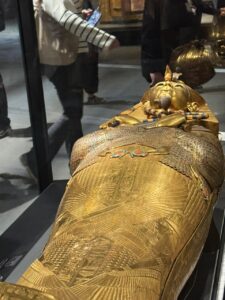
This gallery showcases the incredible evolution of ancient Egyptian funerary architecture during the New Kingdom. While the pyramids were the giants of the Old Kingdom, the New Kingdom focused on hidden rock-cut tombs in the Valley of the Kings. The GEM allows you to see the golden masks, chariots, and even the king’s clothing, providing an intimate look at the spiritual and daily life of a pharaoh.
Stage 5: The Solar Boat – Sailing Through the Afterlife
One of the most complex Great Pyramid of Giza history and construction techniques involves the Khufu Solar Boat. Discovered in a sealed pit at the base of the Great Pyramid, this 43-meter-long cedarwood vessel was reconstructed from 1,224 individual pieces without a single metal nail.
The boat’s move to the GEM is a highlight of the Grand Egyptian Museum visitor experience and highlights. Now housed in a specialized, climate-controlled building, the boat allows visitors to see the ancient Egyptian mastery of shipbuilding. It illustrates how the evolution of ancient Egyptian funerary architecture wasn’t just about stone—it was about providing the pharaoh with every tool, including a literal ship, to navigate the celestial Nile in the afterlife.
Stage 6: The Grand Staircase – A Procession of Gods
The final ascent of the Grand Egyptian Museum visitor experience and highlights is the Grand Staircase. This 60-meter-tall vertical gallery features 87 monumental statues of kings and deities. As you climb, you literally walk through time, witnessing the evolution of ancient Egyptian funerary architecture through the changing styles of royal portraiture.
At the summit of the staircase, you reach the Panoramic Terrace. Here, the museum’s glass walls frame the Giza Pyramids in a breathtaking view. This visual bridge links the Great Pyramid of Giza history and construction techniques outside to the artifacts inside, reminding every visitor that Egypt’s story is a continuous thread of innovation stretching from the dawn of time to the present day.
Essential Visitor Summary
Feature
Giza Pyramids
Grand Egyptian Museum
Primary Focus
Great Pyramid of Giza history and construction techniques
Grand Egyptian Museum visitor experience and highlights
Architectural Style
Evolution of ancient Egyptian funerary architecture
Contemporary desert-themed geometry
Key Artifacts
The Sphinx, Queen’s Pyramids
Tutankhamun Collection, Solar Boat
Travel Tip
Visit at 8:00 AM for soft light
Book the Tutankhamun wing in advance
: The Great Pyramid – A Masterclass in Precision
The Great Pyramid of Giza history and construction techniques represent a level of engineering that remains the gold standard for structural integrity. Built for Pharaoh Khufu (Cheops) around 2550 BC, the pyramid was the tallest man-made structure in the world for over 3,800 years.
To understand its construction, one must look at the sheer scale:
Materials: It consists of an estimated 2.3 million stone blocks. Most are nummulitic limestone quarried locally at Giza, but the interior King’s Chamber is lined with 80-ton granite blocks brought from Aswan.
Accuracy: The base is a near-perfect square, with sides of roughly 230.4 meters (756 feet). The corners are aligned to the cardinal points (North, South, East, West) with an error of less than 0.05 degrees.
Techniques: Evidence like the Diary of Merer (discovered in 2013) reveals that teams of elite workers transported the white Tura limestone casing by boat along specially constructed canals that reached the foot of the plateau.
Stage 2: The Evolution of Funerary Architecture – From Giza to GEM
The evolution of ancient Egyptian funerary architecture is a journey of spiritual ambition. The Giza Plateau was the peak of the “Old Kingdom” style, where the tomb was a literal mountain of stone. However, the spiritual intent was always the same: protecting the Ka (spirit) and providing the king with the tools for the afterlife.
In 2026, the GEM serves as the modern bookend to this evolution. While the pyramids were designed to be sealed and inaccessible, the museum is designed to be transparent and educational. It mimics the pyramid’s geometry with its translucent alabaster facade and its “Grand Staircase,” which chronologically organizes 87 colossal statues. This shift—from a private tomb to a global repository—marks the final stage in the evolution of ancient Egyptian funerary architecture.
Stage 3: The Grand Egyptian Museum – Atrium and Grand Staircase
https://vt.tiktok.com/ZSQUdaac7/
The Grand Egyptian Museum visitor experience and highlights begin the moment you enter the monumental glass atrium. Standing as the museum’s anchor is the 3,200-year-old colossal statue of Ramses II, which was moved from Ramses Square in a highly publicized military-style operation.
Highlights of the Atrium and Staircase include:
The Hanging Obelisk: The world’s first hanging obelisk greets visitors at the entrance, allowing you to see the cartouches on its base—a view unseen for thousands of years.
The Grand Staircase: This “vertical gallery” features 87 statues and architectural elements. As you climb, you follow the evolution of ancient Egyptian funerary architecture, witnessing the artistic shift from the rigid, powerful forms of the Old Kingdom to the graceful, naturalistic styles of the New Kingdom.
The Framing of History: At the top of the stairs, the architecture intentionally frames the Great Pyramid of Giza through a massive glass wall, linking the artifacts directly to their original source.
Stage 4: The Tutankhamun Galleries – A King’s Full Treasury
The absolute crown jewel of the Grand Egyptian Museum visitor experience and highlights is the dedicated Tutankhamun wing. For the first time in history, all 5,000+ objects found in his tomb are displayed together.
Key features of this experience:
The Golden Mask and Throne: Housed in a specialized, high-security climate-controlled zone, these pieces showcase the pinnacle of ancient craftsmanship.
The Chariots and Weapons: Visitors can see the king’s actual hunting chariots and leather armor, illustrating that he was more than just a “boy king” but a ruler prepared for battle in the next world.
The Discovery Zone: Interactive displays recount the 1922 discovery by Howard Carter, providing context to the evolution of ancient Egyptian funerary architecture during the turbulent Amarna period.
Stage 5: The Khufu Solar Boat – A Ship for the Stars
Perhaps the most impressive technical highlight is the Khufu Solar Boat Museum. This 43-meter-long cedarwood vessel was found buried at the base of the Great Pyramid and was moved to the GEM in a single, 48-hour operation using a specialized remote-controlled vehicle.
This boat is a vital part of the Great Pyramid of Giza history and construction techniques. It was built without a single metal nail; instead, the wood was “sewn” together with vegetable fibers that expanded when wet, making the ship watertight. Its presence at the GEM allows visitors to understand that the pharaoh’s journey was not just static—he required a literal fleet to navigate the celestial Nile.
Stage 6: The Main Galleries – Egypt’s 7,000-Year Narrative
Beyond the gold of the pharaohs, the Grand Egyptian Museum visitor experience and highlights include the “Main Galleries,” which cover the vast span of Egyptian history.
Thematic Organization: Unlike traditional chronological museums, the GEM uses four main themes: Kingship, Belief, Society, and State. * Digital Integration: Augmented reality (AR) stations allow you to “reconstruct” broken statues or see the original colors of the evolution of ancient Egyptian funerary architecture as they would have appeared 4,000 years ago.
Quick Guide: Giza & GEM in 2026
Feature
Giza Plateau
Grand Egyptian Museum (GEM)
Primary Theme
Great Pyramid of Giza history and construction techniques
Grand Egyptian Museum visitor experience and highlights
Access
Daily 08:00 – 17:00
Daily 09:00 – 18:00 (Wed/Sat until 21:00)
Top Landmark
The Great Sphinx
Tutankhamun’s Golden Mask
Best For
Physical scale and desert views
Context, history, and treasure
Standing at the edge of the Giza Plateau, looking up at the only surviving Wonder of the Ancient World, is a moment that redefines your perspective on human history. The Great Pyramid of Khufu is not just a monument; it is a 4,500-year-old riddle cast in limestone and granite. To truly appreciate what you are looking at—and to ensure your visit is seamless and awe-inspiring rather than overwhelming—you need to understand both the monumental history that built this place and the practical realities of navigating it today.
Part 1: The Deep Roots of the Giza Plateau
To understand the Great Pyramid of Giza history and construction techniques, you must first understand the evolution of ancient Egyptian funerary architecture. The pyramids did not simply appear out of nowhere; they were the culmination of centuries of architectural trial, error, and spiritual evolution.
Before the Old Kingdom, early Egyptian rulers were buried in mastabas—flat-roofed, single-story rectangular mud-brick structures built over underground burial chambers. As the pharaoh’s status shifted from a tribal leader to a living god, their final resting places grew in ambition.
This structural journey reached its mathematical zenith around 2560 BCE when Pharaoh Khufu commissioned his eternal house. Moving from the multi-layered steps to a geometrically perfect, smooth-sided “true pyramid,” Egyptian architects created a physical manifestation of the sun’s rays, serving as a celestial ramp for the pharaoh’s soul to ascend into the heavens.
Part 2: Demystifying Ancient Construction Techniques
The Great Pyramid of Giza history and construction techniques have fueled countless myths, but the reality discovered by archaeologists is far more impressive than any science fiction theory.
The monument consists of an estimated 2.3 million stone blocks, weighing an average of 2.5 tons each, with some of the massive granite beams inside the King’s Chamber weighing up to 80 tons. The precision is astonishing: the base is level to within 15 millimeters, and the sides are aligned almost perfectly to the four cardinal points of the compass.
Logistics, Ramps, and the Real Workforce
The Workforce: Archaeological excavations at the nearby Workers’ Village have completely debunked the myth of slave labor. The pyramid was built by a highly organized conscripted workforce of tens of thousands of skilled artisans, builders, and temporary laborers who were well-fed on beef, fish, and beer, and received high-quality medical care.
The Materials: While the bulk of the interior was quarried locally on the Giza Plateau, the gleaming white Tura limestone casing stones were ferried across the Nile, and the heavy granite blocks were transported from Aswan—over 800 kilometers upstream—using the river’s annual floodwaters to float heavy transport barges close to the construction site.
The Physics: To lift these massive blocks without iron tools or complex pulleys, workers utilized copper saws, dolerite hammers, and a system of massive earthen supply ramps. Lubricating the pathways with water-soaked clay drastically reduced friction, allowing teams of men to haul the stones up the growing structure using thick papyrus ropes.
Part 3: Essential Logistics for the Modern Traveler
A visit to Giza is an incredible adventure, but because it sits directly on the edge of a bustling metropolis, it can feel beautifully chaotic. Navigating it successfully requires preparation.
The 2026 Ticket and Payment Rules
Egypt has completely transitioned its major archaeological sites to a strict cashless system. You cannot buy entry tickets with cash at the gates.
General Site Ticket: Costs 700 EGP (around $15 USD), giving you access to the plateau landscape, the exteriors of all three major pyramids, and the Great Sphinx area.
Great Pyramid Interior Ticket: If you want to go inside the Great Pyramid of Khufu, you must buy a separate ticket for 1,500 EGP (around $30 USD).
⚠️ Critical Tip: Interior tickets for the Great Pyramid are limited to only 150 visitors per day. They sell out rapidly. To secure one, you must arrive at the official ticket window right when the gates open or purchase them online through the official Ministry of Antiquities portal well in advance.
Part 4: The Reality of Stepping Inside the Great Pyramid
Deciding whether to enter the interior of the Great Pyramid is a personal choice. Inside, you will not find gold, hieroglyphs, or treasures—those were moved or stolen millennia ago. Instead, you are paying to experience the architectural anatomy of the structure.
Health Warning: The interior is intensely hot, humid, and requires a continuous crouched climb. If you suffer from severe claustrophobia, asthma, heart conditions, or limited mobility, it is highly recommended to skip the interior and enjoy the magnificent exterior spaces instead.
Part 5: Insider Tips for a Flawless Giza Experience
To keep your focus entirely on the wonder of the site, keep these practical survival tips close at hand:
The Early Advantage: The gates open at 7:00 AM in the summer and 8:00 AM in the winter. Arrive at opening time. This allows you to beat the intense desert heat and explore the site for nearly two hours before the massive tour buses arrive around 10:00 AM.
Photography: The early morning sun bathes the eastern faces of the pyramids in a warm, golden glow, and the air is clear of the midday haze, offering the perfect light for photography. Standard smartphone photography is free across the plateau and inside the pyramids, but using professional cameras or tripods requires an extra fee.
Great Pyramid of Giza history and construction techniques
What to Wear and Pack
Footwear: Leave sandals and flip-flops at your hotel. The plateau terrain is completely uneven, rocky, and covered in fine desert sand. Wear sturdy, broken-in sneakers or hiking shoes.
Sun Shielding: The Giza Plateau offers absolutely zero natural shade. Bring a wide-brimmed hat, sunglasses, and high-SPF sunscreen. Modest, loose, breathable cotton or linen clothing is highly recommended out of respect for the local culture and to protect your skin from the sun.
Hydration: Bring a large bottle of water (at least 1.5 liters per person) bought in Cairo before arriving. Water prices from vendors inside the complex are heavily marked up.
see the other options of tours with momo tours Egypt by clicking here https://momotoursegypt.com/wp-admin/post.php?post=4330&action=edit
Managing the Plateau Vendors
Because Giza is iconic, you will encounter local vendors offering camel rides, horse carriages, postcards, and souvenirs.
The Polite Refusal: If you are not interested, simply look them in the eye, smile, say a polite but firm “La, shukran” (No, thank you), and keep walking. Do not engage in casual conversation if you do not want to buy anything.
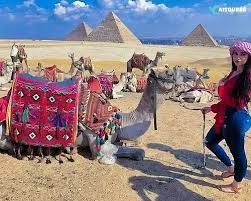
Camel Rides: If you want that classic desert photograph, camel rides are a wonderful experience, and the government sets official hourly rates (around 500 EGP per hour). Always agree explicitly on the final price before mounting the camel, and clearly confirm that the price covers the entire ride for both of you to avoid any misunderstand
WorldHeritageSite.org – Pyramids (Memphis): https://www.worldheritagesite.org/list/pyramids‑memphis/ World Heritage Site
UNESCO – Ancient Thebeshttps://momotoursegypt.com/trip/west-bank-luxor-tour-valley-of-the-kings-valley-of-the-queens-hatshepsut-temple-ramesseum-colossi-of-memnon-optional-hot-air-balloon-ride/ with its Necropolis (Luxor / Thebes): https://whc.unesco.org/en/list/87/UNESCO World Heritage Centre
🌟 Ready to cross Giza off your bucket list without the stress? Don’t navigate the busy crowds, shifting ticket rules, or transportation hassles alone. Let our expert Egyptologists show you the real history, guide you seamlessly through the plateau, and transition you straight to the Grand Egyptian Museum in private, air-conditioned comfort.
👉 Design Your Custom Cairo Day Tour with Momo Tours Egypt Today