If you are planning to explore the wonders of ancient Egypt in a single unforgettable experience, a saqqara and giza pyramids day tour is one of the most rewarding journeys you can take. Combining two of the most important archaeological sites in the world, this full-day adventure offers travelers a complete understanding of pyramid evolution, royal tombs, and the golden age of the Old Kingdom.
Organized professionally by Momo Tours Egypt, a well-structured saqqara and giza pyramids day tour allows you to move beyond basic sightseeing and dive deep into the history, symbolism, and engineering brilliance of ancient Egypt.
From the legendary Pyramids of Giza to the groundbreaking Step Pyramid complex in Saqqara, this guide explains everything you need to know before booking your experience.
Why Is a Saqqara and Giza Pyramids Day Tour the Best Way to Explore Ancient Egypt?
Many travelers only visit Giza and miss the crucial chapter that explains how pyramid construction began. A saqqara and giza pyramids day tour connects the story from the earliest pyramid design to the perfection seen at Giza.
At Saqqara, you will visit:
-
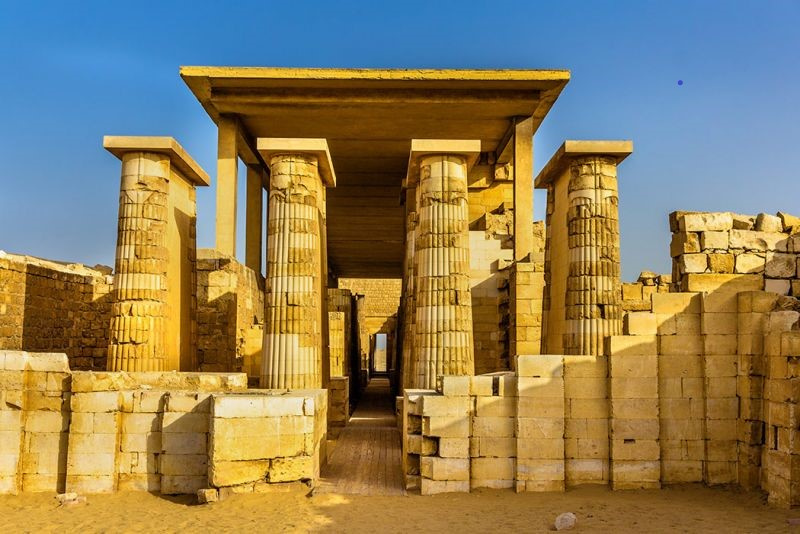
Pyramid of Djoser
-
Ancient mastaba tombs
-
The vast Saqqara necropolis
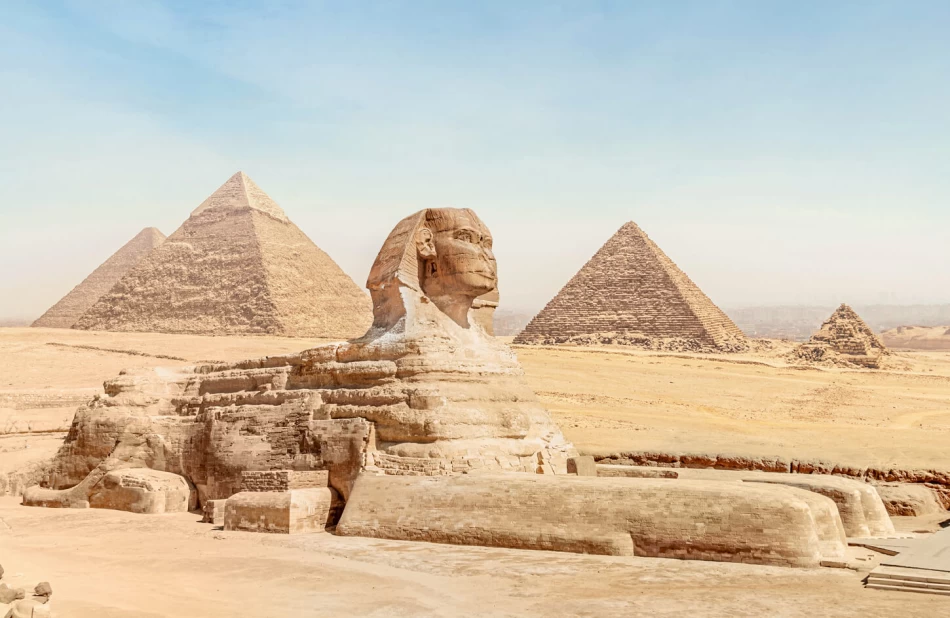
At Giza, you will explore:
-
Great Pyramid of Khufu
-
Pyramid of Khafre
-
Pyramid of Menkaure
-
Great Sphinx of Giza
A complete saqqara and giza pyramids day tour gives you historical continuity that most visitors miss.

What Can You Expect During a Saqqara and Giza Pyramids Day Tour?
A professional saqqara and giza pyramids day tour typically begins in Cairo with comfortable transportation arranged by Momo Tours Egypt.
Your day includes:
-
Guided exploration with a licensed Egyptologist
-
Detailed storytelling about pyramid construction
-
Time for photography at panoramic desert viewpoints
-
Cultural insights into ancient burial traditions
Unlike rushed group visits, a structured saqqara and giza pyramids day tour ensures each site receives the attention it deserves.
Why Is Saqqara Essential in a Saqqara and Giza Pyramids Day Tour?
Saqqara represents the beginning of pyramid architecture. The Pyramid of Djoser, built during the 3rd Dynasty, is considered the world’s first large-scale stone structure.
This early pyramid design shows the transformation from simple mastaba tombs to monumental pyramids. Without including Saqqara, a saqqara and giza pyramids day tour would feel incomplete from a historical perspective.
The vast necropolis also contains beautifully decorated tombs that reveal daily life scenes from ancient Egypt.
How Do the Giza Pyramids Complete the Saqqara and Giza Pyramids Day Tour Experience?
After understanding pyramid evolution at Saqqara, the Giza Plateau reveals the peak of architectural perfection.
The Great Pyramid of Khufu remains the only surviving wonder of the ancient world. Its size, alignment, and precision continue to amaze engineers and historians.
Including Giza in your saqqara and giza pyramids day tour allows you to witness the final stage of pyramid development.
The nearby Great Sphinx of Giza adds mystery and symbolism, guarding the plateau for thousands of years.
When Is the Best Time to Book a Saqqara and Giza Pyramids Day Tour?
The cooler months between autumn and spring provide the most comfortable conditions.
For the best experience during your saqqara and giza pyramids day tour:
-
Start early in the morning
-
Wear comfortable walking shoes
-
Bring sun protection
-
Stay hydrated
Early planning ensures a smoother and more enjoyable saqqara and giza pyramids day tour.
How Long Does a Saqqara and Giza Pyramids Day Tour Take?
A full saqqara and giza pyramids day tour typically lasts an entire day, allowing enough time for:
-
Travel between sites
-
Guided explanations
-
Photography stops
-
Short rest breaks
Rushing these monumental sites reduces their impact. Momo Tours Egypt ensures balanced pacing throughout your saqqara and giza pyramids day tour.
Why Choose Momo Tours Egypt for Your Saqqara and Giza Pyramids Day Tour?


Selecting the right tour operator makes a significant difference.
Momo Tours Egypt provides:
-
Licensed professional Egyptologists
-
Personalized itineraries
-
Organized logistics
-
Comfortable transportation
-
Deep cultural insight
Their expertise ensures your saqqara and giza pyramids day tour becomes an educational and seamless experience rather than just a checklist visit.
What Makes This Tour Ideal for International Travelers?
A saqqara and giza pyramids day tour is perfect for visitors from the USA, UK, Canada, Australia, and Europe who want to maximize limited travel time in Egypt.
Instead of spreading visits across multiple days, this tour offers a concentrated yet comprehensive experience of Egypt’s pyramid history.
Momo Tours Egypt specializes in serving international guests with professionalism and cultural sensitivity.
How Can You Prepare for a Saqqara and Giza Pyramids Day Tour?
Preparation improves your comfort:
-
Wear breathable clothing
-
Carry identification
-
Bring a camera
-
Plan for moderate walking
-
Keep valuables secure
Following these tips ensures your saqqara and giza pyramids day tour runs smoothly from start to finish.
A well-organized saqqara and giza pyramids day tour offers one of the most powerful historical experiences in the world. From the revolutionary Step Pyramid at Saqqara to the majestic pyramids of Giza, you witness the evolution of ancient Egyptian engineering across centuries.
With professional organization by Momo Tours Egypt, your saqqara and giza pyramids day tour becomes more than a sightseeing trip — it becomes a journey through time.
If you want to understand Egypt’s ancient civilization in one comprehensive day, this is the tour that delivers depth, context, and unforgettable memories.
Frequently Asked Questions
Is a saqqara and giza pyramids day tour suitable for families?
Yes, families can comfortably enjoy the tour with proper planning and guidance.
Is entering the pyramids included in a saqqara and giza pyramids day tour?
Entry inside pyramids is optional depending on visitor preference and physical comfort.
How physically demanding is the tour?
Moderate walking is required across desert terrain and archaeological areas.
Do I need a private guide?
While not mandatory, a professional guide significantly enhances your saqqara and giza pyramids day tour experience.
In the Heart of Ancient Egypt: The Ultimate Guide to the Giza & Saqqara Day Tour
Imagine a day where time rewinds. You find yourself standing in the shadow of colossal stone giants, their peaks piercing the sky just as they have for over 4,500 years. This is not merely a sightseeing excursion—it is a profound immersion into the very foundation of human civilization.
A day trip that bridges the Giza Plateau and the necropolis of Saqqara is a journey through the “evolution of immortality.” Here, you will witness the architectural leap from simple brick tombs to the perfect geometric shapes that became the universal symbol of eternity.
Part 1: Your Journey — From Step Pyramids to Great Wonders
Morning: Saqqara — The Cradle of the Pyramids
Your day begins not with the most famous sites, but with the most significant ones for understanding history. Saqqara is an “open-air library.”
-
The Pyramid of Djoser (Step Pyramid): This is the world’s first major stone project. Your guide will explain how the architect Imhotep revolutionized construction by stacking several mastabas (tombs) to reach toward the heavens.
-
The Pyramid Texts: Inside the royal pyramids (such as those of Teti), you will see the oldest religious texts ever found, carved directly into the walls—an ancient “instruction manual” for the pharaoh’s soul in the afterlife.
-
Tombs of the Nobles: These walls are adorned with breathtaking reliefs that bring daily life in Ancient Egypt to life: hunting, harvesting, dancing, and elaborate festivals.
Afternoon: The Pyramids of Giza — The Pinnacle of Majesty
After soaking in the history of Saqqara, we head to the Giza Plateau. This is the climax of your journey.
-
The Three Great Pyramids: You will stand before the Pyramids of Khufu, Khafre, and Menkaure. Your guide will unravel the engineering mysteries: how 2.3 million stone blocks were transported, cut, and aligned with such astronomical precision.
-
The Panoramic Viewpoint: We take you to the prime location for photos, where all three pyramids align in the perfect perspective.
-
The Great Sphinx and Valley Temple: You will learn why this guardian—with a pharaoh’s head and a lion’s body—remains the most enigmatic creature in history. In the Valley Temple, you will witness where the mummification rituals took place before the final journey into the afterlife.
Part 2: The Role of Your Egyptologist
Many ask: “Why do I need a guide? Can’t I just buy a ticket and walk around?” In Egypt, a guide is not just someone reciting dates; they are your translator for the language of stone.
What a professional Momo Tours guide does for you:
-
Context Over Rocks: Without a guide, you see piles of stone. With one, you see engineering innovations, religious dogmas, and human drama. They explain the “why” and “how” behind every monument.
-
Attention Management: Egypt’s sites can be overwhelming with local vendors and “helpers.” Your guide acts as your protective barrier, ensuring you are never harassed and can enjoy the site in peace.
-
Logistical Shield: Cairo’s traffic and the complex rules of site entry require deep local knowledge. We design your route to bypass the crowds, avoid long queues, and keep you away from the midday heat.
-
Access to Hidden Details: Your guide knows exactly where the most beautiful reliefs are, which extra tombs are worth the small fee to enter, and the best angles for photography that typical tourists miss.
Part 3: Practical Information & Pricing
Note: Pricing can vary based on season and group size. We believe in transparency—you pay for a premium, hassle-free service.
Estimated Pricing (2026):
-
Group Tour: Starting from $40 – $90 per person (includes transport, guide, water; entry tickets typically paid at the gate).
-
Private VIP Tour: Starting from $150 – $250 per person (includes private vehicle, personal Egyptologist, premium logistics, and total flexibility).
What is Included in Our Standard Service:
-
A licensed, professional Egyptologist.
-
A comfortable, air-conditioned vehicle with a professional driver.
-
Bottled water throughout the day.
-
Full assistance with ticket purchasing and site navigation.
What is NOT Included:
-
Site entrance tickets (government-regulated).
-
Entry inside the pyramids (requires an extra ticket).
-
Tipping (an integral part of Egyptian culture; we will guide you on the appropriate etiquette).
-
Lunch (we will take you to a trusted, authentic local restaurant).
Why Choose Momo Tours Egypt?
We are not just a tour agency; we are local experts who live and breathe Egypt.
-
Transparency: You always know exactly what you are paying for. We do not drag you to papyrus or perfume shops unless you explicitly ask. We value your time.
-
Safety: We prioritize your security, working only with verified drivers who master Cairo’s chaotic traffic.
-
Personalization: Your tour is yours. If you want to spend extra time in Saqqara or capture the perfect sunset at Giza, we adapt. Your satisfaction is our priority.
Ready to Begin Your Journey?
History is waiting. Don’t let your travel dates fill up.
Connect with us today:
-
Visit our website: momotoursegypt.com
-
Follow us on Instagram: Momo Tours Egypt
Let’s turn your vacation into a legend. At Momo Tours Egypt, we ensure that when you head home, you carry with you not just souvenirs, but a piece of eternity.
Echoes of Eternity: Unveiling the Mysteries of Saqqara, Memphis, and Giza
A journey through the Memphite necropolis and the Giza Plateau is a passage through time, revealing the layers of one of humanity’s most sophisticated civilizations. From the subterranean chambers of the Serapeum to the silent, watchful gaze of the Great Sphinx and the storied ruins of Memphis, these sites tell the story of a culture obsessed with eternity. To conclude this journey, a visit to a traditional carpet school offers a bridge to the living heritage that persists in Egypt to this day.
The Serapeum: The Catacombs of the Sacred Bulls
Tucked away in the desert sands of Saqqara lies one of Egypt’s most haunting and enigmatic sites: the Serapeum. While the pyramids are temples to the kings, the Serapeum is a monument to the divine animal cults that defined Egyptian religious life for millennia.
The Serapeum served as the final resting place for the Apis bulls, animals believed to be the living incarnations of the god Ptah of Memphis. During their lifetimes, these bulls were pampered in luxurious stables, their movements interpreted as oracles. Upon death, they underwent a complex embalming process and were interred with a solemnity typically reserved for royalty.
Descending into the underground galleries, visitors are struck by the sheer engineering prowess required to carve these tunnels. Within the chambers rest massive granite sarcophagi, each weighing several dozen tons. How they were maneuvered into these tight, subterranean spaces remains a subject of modern debate. For the ancients, these boxes were not merely stone coffins; they were vessels for the soul of the bull to achieve immortality as Osiris-Apis, or Serapis—a deity whose influence would eventually ripple across the Mediterranean during the Hellenistic period.
Memphis: The White Wall of Antiquity
A short distance from Saqqara lie the humble yet profound ruins of Memphis. Founded around 3000 BCE by King Menes, the city was the first capital of a unified Egypt. Known then as Ineb-Hedj (“White Walls”), it served as the political and religious anchor of the Old Kingdom.
Though little of the bustling city remains today, its significance is monumental. Memphis was the “Home of the Ka of Ptah,” the creator god. It was here that pharaohs were crowned and where the greatest minds of the ancient world—including, according to legend, Plato and Democritus—came to study under the city’s high priests.
Today, the open-air museum at Mit Rahina allows you to stand in the shadow of the colossal limestone statue of Ramses II. This fallen giant, once an architectural marvel, reminds us of the fragility of even the most powerful empires. Near it, an alabaster sphinx, carved with masterful precision, rests in silent witness to the city’s former glory. Memphis is a poignant reminder that even the greatest cities eventually return to the earth, leaving behind only echoes of their past influence.
The Great Sphinx: The Guardian of Giza
No exploration of Egypt is complete without standing before the Great Sphinx of Giza. Carved from the bedrock of the plateau during the Old Kingdom—most likely under the reign of Khafre—this monumental sculpture is the oldest and largest of its kind.
The Sphinx is an architectural paradox: a creature with the head of a man and the body of a lion, symbolizing the fusion of human intellect and animal strength. Throughout its 4,500-year history, it has seen the desert sands swallow it whole and seen them cleared away by successive generations of rulers. It has stood through the transition from polytheism to the influence of Greek and Roman ideologies, and it has outlasted the very dynasties that sought to immortalize themselves in its likeness. To stand before the Sphinx is to realize the true scale of time; it is a sentinel that has watched the world change while remaining perpetually frozen in its ancient vigil.
The Art of the Loom: Egyptian Carpet Schools
After immersing yourself in the monumental history of the stones, a visit to a traditional carpet school offers a different kind of insight into the Egyptian soul. Carpet weaving in Egypt is a craft that blends the influences of the Mamluk and Ottoman eras with a unique Egyptian artistic sensibility.
In places like Saqqara, carpet schools serve as both factories and training grounds, where the tradition is passed from one generation to the next. These workshops provide a fascinating contrast to the ruins: they are full of life, color, and the rhythmic sound of looms.
Why Visit a Carpet School?
-
Cultural Preservation: These schools are often the last bastions of hand-woven techniques that are threatened by mass industrial production. Supporting them helps keep ancient artistic patterns alive.
-
Symbolism: Carpet designs are rarely just decorative. Geometric patterns often represent the universe, while floral motifs may signify growth and fertility. Artisans use these patterns to tell stories of the land and its people.
-
Quality and Craft: Unlike machine-made rugs, hand-knotted Egyptian carpets are renowned for their durability and the use of natural dyes. A carpet made in a traditional school is a lifetime investment, often utilizing wools and silks that reflect the quality standards of a bygone era.
A Guide to Your Visit
When visiting these workshops, remember that you are witnessing a labor-intensive art form. The value of a carpet lies in the number of knots per square inch and the complexity of the design. If you choose to purchase, you aren’t just buying a souvenir; you are acquiring a piece of contemporary Egyptian heritage that has evolved alongside the history of the country itself.
Conclusion
From the deep, silent vaults of the Serapeum to the expansive history of Memphis and the enduring gaze of the Sphinx, this region is the cradle of the Egyptian spirit. And by stepping into a local carpet school, you finish your journey by connecting with the hands that continue to weave beauty into the fabric of Egyptian life today. This is the Egypt that stays with you—a place where the ancient and the modern are not separate, but two sides of the same timeless coin.